Cost of Patrick G And Shirley W Ryan Center for the Musical Arts Music Building

The Northwestern Academy Lakefill (formally known as the James Roscoe Miller Campus) is a large area of Northwestern University state that was reclaimed from Lake Michigan in 1962–1964 by creating a seawall of limestone blocks quarried in Illinois and Indiana and using landfill materials from the structure of the Port of Indiana. The lakefill resulted from the academy's demand to expand the campus's physical footprint; Northwestern President J. Roscoe Miller received permission from the boondocks of Evanston and the Illinois legislature (besides as many other groups) to reclaim 74 acres (30 hectares) of underwater land. This well-nigh doubled the size of the previously 85 acres (34 hectares) campus. In 1968, the lakefill was expanded by an additional 10 acres (four.0 hectares) on the southern end of the campus.[one] [2] [three]
Equally solid ground was established, Northwestern began the construction of the Northwestern University Library, the Norris University Center and the Pick-Staiger Concert Hall, all built from 1970–1975.
History and creation [edit]
Talks to aggrandize the campus via lakefront had started in 1893, and were again brought up in 1930. Information technology was not until October 1960 that the academy formally appear their plans of expansion. Structure then started in July 1962, following the city of Evanston's final approval. Creation of the lakefill was reinforced by the university's need to expand, but in a style that did not oversupply the campus with more than buildings, or infringe on Evanston state. Expanding out toward the lake too came at a cheaper cost, estimated at around $113,000/acre to build out onto the lake versus around $300,000/acre to expand further into the metropolis of Evanston.
Extensive country and local government cooperation was needed in lodge to buy and build upon the lakefront. Following unanimous blessing by both the Illinois House and Senate, as well as and then current governor Otto J. Kerner, the state of Illinois allowed Northwestern to purchase underwater property for $100 an acre.[4] Following the purchase of the land, the university obtained permission from the U.S. Army Corps of Engineers on September 6, 1961, and finally began construction on the lakefill in July 1962.
The telescopic of the project evolved into a 20-year plan, including the construction of multiple scholastic, gallery, and performance buildings, alongside space for recreational and able-bodied activities on the campus. The large swimming inside the middle of the lakefill was included not just for aesthetic purposes of the campus, but additionally to serve as the cooling reserve for Northwestern'southward Primal Utility Plant. The placement of each attribute on the new lakefill was meant to unify both the north and south ends of campus, and the pattern of the paths was focused on creating both a relaxing surroundings and pedestrian-oriented campus.[1] [5]
Lakefront [edit]

Lakefront as seen from north cease of lakefill facing south towards Chicago

Lakefill in the fall (Nov), facing west towards campus

Lakefill in the winter (January 2021) later snow.

Lakefill geese with goslings. Herons and other birds also frequent the area.
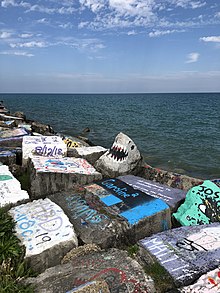
A painted rock at the lakefill.

Paintings, doodles, and messages often appear on the lakefill rocks which class the breakwaters (August 2021).
The eastern portion of the lakefill consists of a peninsula, creating a modest lagoon in the centre of the new campus. The peninsula is designed as a park-like surface area with paths for jogging and biking.[five]
The eastern shore of the lakefill, facing Lake Michigan, is composed of rocks intended to blot waves from the lake. Those that remain above the waters are frequently painted, by and large past Northwestern students. Students began painting the rocks in 1970, within a few years of the lakefill'south structure. Paintings include doodles, inside jokes, and several union proposals, and the messages carry an overall trend of optimism.[half dozen] [seven] [8]
Although the lakefill campus refers to the total 74 acres created from 1962–1964, students often use the term "lakefill" to describe this specific lakefront area, which is a frequent gathering place on campus. The space is used to host events such as Dillo Day, the largest student-run music festival in the country,[9] and the local Relay for Life program. In the spring of 2016, a programme called ART BOX was started to provide an area on the lakefill to be used by multiple groups across campus for smaller theatrical performances, musical performances, and art exhibits.[10] [11]
The lakefill has become an integral function of campus and student life as a space for unwinding, working out or coming together for these greater events and traditions. This was also shown when the winning idea for Northwestern'due south Associate Educatee Government (ASG) 5K Initiative, an initiative introduced to improve student life on campus, in 2012, was the implementation of "WiFi on the Lakefill" later roughly 700 Northwestern students voted in a school-wide poll. The projection was completed within the year.[12] Over the summertime, hammocks are a frequent sight equally groups of students erect their hammocks around the lakefill or bring a book and hammock solo. In 2021, work was performed to add more than rocks to the lakefront edge to preclude erosion from occurring, and a small strip of land on the southwest end was allowed to run wild with tall grasses and flowers. It is unclear whether this will be mowed in the futurity or is a permanent feature of the lakefill.
Buildings [edit]
The lakefill is dwelling to many key buildings on the Northwestern campus, many of which enjoy a direct view of Lake Michigan.
Northwestern University Library [edit]
1 of the offset additions to the lakefill campus was the Northwestern University Library, which began construction in 1966, and opened in 1970. Information technology replaced the Charles Deering Library equally the chief library on campus, and is continued to the Deering Library. The building consists of three towers and a basement expanse, each devoted to a certain area of written report. Designed by builder Walter Nesch, the edifice is meant to evoke both a Brutalist architecture style and the Gothic style of the quondam Deering Library.[thirteen]
Patrick G. and Shirley W. Ryan Center for the Musical Arts [edit]
Northwestern Academy first planned the reconstruction of the Bienen School of Music in February 2008. After competing with 25 architect companies, Chicago-based Goettsch Partners won the design of this giant glass building. Structure started on May eighteen, 2012, and opened for classes in the fall of 2015.[14]
The exterior of the edifice consists mainly of glass, taking reward of the shorelines and skyline of neighboring Chicago. The base of the building features a limestone base with additions of concrete in some middle pillar parts of the interior, too serving every bit the separation wall for Mary B. Galvin Recital Hall, which offers a direct view of the lake and downtown Chicago. Part of the building likewise rests on the lakefill, as it partly integrates the existing Regenstein Hall of Music on all 3 levels.
The Ryan Eye has three new performance venues, including the 400-seat Mary B. Galvin Recital Hall, 150-seat black box Shirley Welsh Ryan Opera Theater, and a 120-seat David and Carol McClintock Choral and Recital Room. The edifice also offices Bienen School of Music departments like admission, fiscal aids, student affairs, career services, as well as the career department of the School of Communication. Instrumental practice rooms occupy the third floor, faculty studios on the fourth. Offices of the deans and administrative staff occupy the 2d, fourth and fifth floor.[14]
Regenstein Hall of Music [edit]
In 1977, the Regenstein Hall of Music was synthetic on the lakefill campus. It was too designed by Walter Nesch, and connects straight to the new Ryan Center for the Musical Arts in two of the three levels.[15]
Norris Academy Eye [edit]
Named in the memory of alumnus Lester J. Norris following a $2.five million donation from his parents, Northwestern's student center was designed by Edward D. Dart, and completed in 1971. The Norris Centre serves as a community hub for students, faculty, staff, alumni and guests.[16]
A New Student Center Initiative was drawn upwards in 2010 by a student-led movement, which chosen for the creation of a more key and modern facility, and argued that this would help promote a greater sense of customs and inclusion on campus. In response, the assistants engaged the consulting business firm Brailsford and Dunlavey to assess this proposal and conduct research on how best to come across the student body'south needs.[17]
On August three, 2016, Northwestern unveiled a model showcasing a major renovation plan of the existing Norris Center, a modern facility called the University Eatables, in hopes to all-time serve the wider Northwestern community. Led by the Sectionalisation of Educatee Affairs with Ennead Architects of New York Urban center and Northwestern's Facility Management, the two-year plan was unanimously approved by the Educational Properties Committee of the University's Board of Trustees.[eighteen]
Athletics buildings and fields [edit]
The Northwestern lakefill additionally serves every bit a dwelling house to many of the Northwestern Athletics fields and facilities. Currently, the lakefill houses the Lanny and Sharon Martin Stadium, Lakeside Hockey Field, and the Chap and Ethel Hutchinson practice field.
Lanny and Sharon Martin stadium opened March 8, 2016, and houses both the Northwestern Wildcat soccer and lacrosse teams. Information technology includes an bogus turf field, full field lighting, permanent seating for up to 2000 fans and a full color video board with recording equipment. The facility is named after alumni and Trustee J. Landis Martin and his married woman, Sharon Martin.[19] [20]
Home of the Northwestern Field Hockey Team, the Northwestern Field Hockey field was congenital in 1997, equally part of the Leonard B. Thomas Athletic Complex. The field includes artificial turf lined for field hockey, a full field lighting and sound system, lighted score board, and permanent seating for up to 300 fans. The field has additionally been the location of the Large Ten Field Hockey Tournament in 2002, 2004, and 2010.[21]
Created as a varsity football athletic practice field, the Chap and Ethel Hutchinson field was opened in the summer of 2016, and is located next to both lakeside field and Martin stadium, aslope the Lake Michigan lakefront.[22]
Henry Crown Sports Pavilion [edit]
Completed in 1987, the Henry Crown Sports Pavilion is located on the northern end of the lakefill. The 95,000 sq ft (viii,800 m2) pavilion, which includes the Lester J. Norris Aquatics Middle, houses a diverse set of exercise equipment, an Olympic-size pond and diving pool, practice courts, studio space, and massage and sauna services. In 2002, an attachment of the Combe Tennis centre, housing half dozen indoor lawn tennis courts was completed.[23] The building itself is commonly referred to as "SPAC" by Northwestern students and faculty, the acronym referencing the "Sports Pavilion" in Henry Crown Sports Pavilion and "Aquatics Heart" in Lester J. Norris Aquatics Center.
Announced in late 2015, to provide further support to student athletes and athletic staff on campus, additional renovations and construction began on the Henry Crown Sports Pavilion to include the new Ryan Fieldhouse and Walter Athletics Center. This addition is being constructed adjacent to the electric current pavilion and will extend further out on the lakefill. The intended project includes the construction of an indoor multi-purpose practise field, nutrition heart, dining facility, athletic support services, rebuilding of indoor basketball courts, and office space for athletic administrators and coaches.[24]
Kellogg Schoolhouse of Direction Global Hub [edit]
Designed by Toronto architectural firm KPMB, the 410,000-square-foot (38,000 m2) glass building on the north side of the lakefill will finish its construction by the cease of 2016, and will include Northwestern University Kellogg Schoolhouse of Management faculty, staff and students, besides equally Weinberg College'due south Department of Economics.[25]
The building consists of a Collaboration Plaza, three stories, a 6,000-square-human foot (560 grandii) visitor center, a two-story White Family Auditorium that holds 350 people, and a Faculty Summit that's besides 2 stories for discussions and debates.[26] Apart from its high technology and flexibility of furniture within classrooms, the edifice is likewise notable for its eco-friendly design that will reduce energy consumption by 30% below standard requirements. Information technology is expected that the Global Hub will receive LEED Gold designation.[25]
References [edit]
- ^ a b "Building View, Northwestern Architecture, Northwestern University Library". digital.library.northwestern.edu . Retrieved 2016-x-21 .
- ^ "Northwestern Compages: The Lakefill". Northwestern University Archives. Retrieved 21 March 2016.
- ^ Pridmore, Jay (2000). Northwestern Academy: Celebrating 150 Years. Northwestern University Press. p. 200. ISBN9780810118294.
- ^ Williamson, Wild, Harold F., Payson S. (1978). Northwestern University, A History: 1850-1975. Evanston, Ill.
- ^ a b "Manufactured Nature --- Northwestern University's Lakefill Campus". brynmawr.edu . Retrieved 2016-10-21 .
- ^ "Dearest, on the rocks". northbynorthwestern.com . Retrieved 2016-ten-21 .
- ^ Wainhouse, Olivia. "Lakefill rocks recall memories, proposals of past students". The Daily Northwestern . Retrieved 2016-10-21 .
- ^ Cohen, Rebecca. "Evanston photographer documents lakeshore rock art". The Daily Northwestern . Retrieved 2016-x-21 .
- ^ "About Dillo Day". Dillo Day . Retrieved August 1, 2021.
{{cite web}}: CS1 maint: url-condition (link) - ^
- ^ Holtzman, Rachel D. "ART BOX festival brings educatee performances to the Lakefill". The Daily Northwestern . Retrieved 2016-10-21 .
- ^ Svitek, Patrick. "ASG project brings WiFi to Lakefill". The Daily Northwestern . Retrieved 2016-ten-21 .
- ^ "Building View, Northwestern Compages, Northwestern University Library". digital.library.northwestern.edu . Retrieved 2016-10-28 .
- ^ a b "Patrick G. and Shirley West. Ryan Center for the Musical Arts: Bienen School of Music - Northwestern University". music.northwestern.edu . Retrieved 2016-x-21 .
- ^ "Facilities: Bienen School of Music - Northwestern Academy". music.northwestern.edu . Retrieved 2016-10-28 .
- ^ "Mission and History: | Northwestern Student Affairs". northwestern.edu . Retrieved 2016-10-28 .
- ^ Floum, Jessica. "Members of NU community express opinions on new educatee center during focus grouping". The Daily Northwestern . Retrieved 2016-10-28 .
- ^ "New University Commons : | Northwestern Pupil Affairs". northwestern.edu . Retrieved 2016-10-28 .
- ^ "J. Landis Martin | Platte River Disinterestedness". platteriverequity.com . Retrieved 2016-10-21 .
- ^ "NU Sports". nusports.com . Retrieved 2016-10-21 .
- ^ "NU Sports". nusports.com . Retrieved 2016-ten-21 .
- ^ "Northwestern To Suspension Footing on Ryan Fieldhouse & Walter Athletics Center". Northwestern University . Retrieved 2016-x-21 .
- ^ "Northwestern University Recreation". nurecreation.com . Retrieved 2016-x-28 .
- ^ "Northwestern To Intermission Ground on Ryan Fieldhouse & Walter Athletics Center". Northwestern University . Retrieved 2016-10-28 .
- ^ a b "Global Hub". Kellogg School of Management. Retrieved 2016-10-21 .
- ^ "Kellogg's new edifice reaches its final elevation -". Kellogg School of Management. Retrieved 2016-10-21 .
0 Response to "Cost of Patrick G And Shirley W Ryan Center for the Musical Arts Music Building"
Post a Comment