How to Review an Entire Deck on Anki
Podcast: Download
Subscribe: Apple Podcasts | Google Podcasts | Stitcher | RSS
Podcast recording updated 04/01/22
 Flick this:
Exams loom on the horizon and y'all're staring at a stack of unread textbooks then big it would brand whatever sane student milk shake in their boots.
Mayhap y'all got behind in your reading over the course of the semester…
Or perhaps your professor assigned additional reading you lot haven't gotten around to even so…
Whatever the example, you have a ton of data to memorize before your exams roll effectually, and you're feeling the pressure.
Well, guess what?
You are not alone! In fact, almost every educatee ends upward feeling like this as the end of the semester approaches. And hardly a calendar week goes by that I'm not asked near how to memorize a textbook and textbook memorization.
The good news is: memorizing a textbook is not every bit difficult as it may seem.
At the finish of the twenty-four hour period, it's not just about memorizing — that would be an utter waste of time!
Instead, the real goal is to understand the books you lot read. And more than than only agreement the content, y'all want to apply the textbooks y'all place in memory to create new cognition .
In this post, yous'll learn how to:
- Correctly fix your expectations of what the book will comprise
- Understand why you lot demand to read the book (or if you actually need to!)
- Quickly decide how much of the volume you actually demand to read
- Make a dedicated Memory Palace system to memorize the parts you really need
- Learn how to take notes from a textbook onto index cards or flashcards, and
- Determine how much time you'll need to practice the information yous've memorized
>>> Yours Gratis: A Private Course With Crook Sheets For Becoming A Retention Master, Starting From Scratch.
If y'all desire to spring to a particular section, you lot can do that here:
How to Memorize a Textbook vs a Volume
Do You Really Demand to Memorize a Book Verbatim?
Set Yourself Upwardly For Success
How to Memorize a Textbook (Realistically)
- Examine the book
- Make an equation
- Get index cards
- Detect the big points and jot them down
- Make use of your Retentiveness Palace
- Create crazy imagery to assist you recall the info
- Stick each crazy epitome onto a Retention Palace station for recall
- Exam yourself before the teacher does
- Allow the info grow into knowledge
- Bonus! Save your knowledge for later on
Example: How to Memorize Verbatim
Bonus Example: How to Memorize a Formula
How to Study a Textbook for Maximum Retention
Want this post in infographic form?
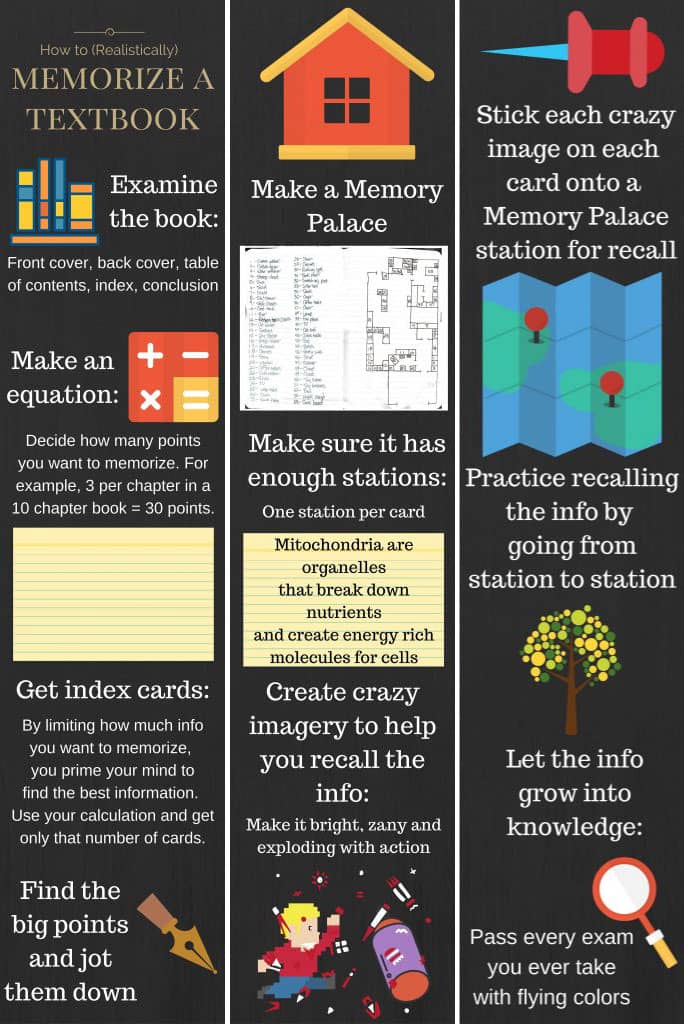
You tin can download this infographic, just like Aldolfo:
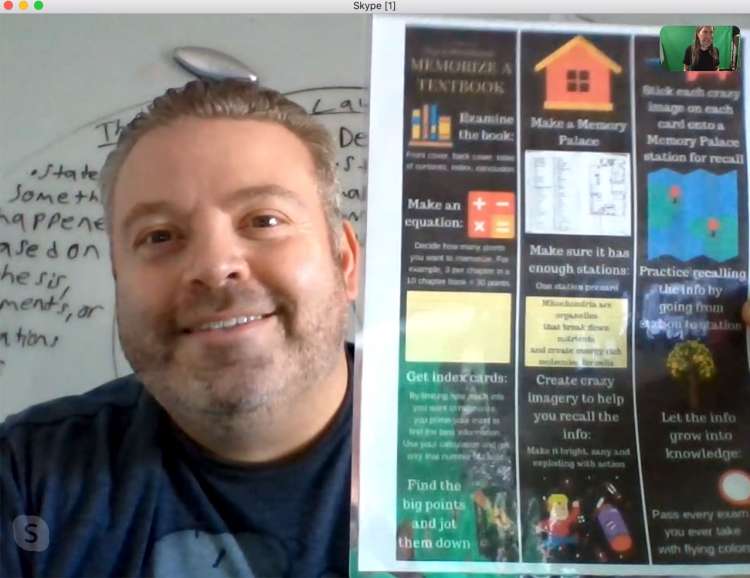
Aldolfo Artigas printed AND laminated this "How to Memorize a Textbook" infographic and now his sons are using the technique as well!
So are you lot set up to learn how to memorize a textbook , the correct way?
Let's get started.
The Question That Inspired This Post
So you may exist wondering: Hey Anthony, if people have been asking y'all well-nigh this topic for then long, what finally fabricated yous decide to write about it?
Well, the truth is, I've written virtually textbook (and volume) memorization before, just never in the context of memorizing an entire textbook.
You can check out my post about how to memorize a chapter out of a textbook . And you might also be interested in some other post I wrote, almost how students with dyslexia can still ace their exams .
In the end, the reason is simple: I decided to write this postal service and record a podcast to help out one of my audience members.
Hither's what this struggling educatee wrote:
"Hi Anthony. I want to memorize some physics, chemistry, and math formulas, and also some texts that I have to memorize verbatim, but it needs a lot of Retention Palaces and too much time. Plus, I don't know how to memorize formulas.
For instance, memorizing sin(A+B)=AcosB+cos .
Do I need just one Loci, and how practise I memorize this? Of course, this is a very unproblematic formula, but exams are coming! I need your help."
Now that we know why this pupil needs assist, allow'southward speedily talk about the differences between a textbook and other kinds of books.
How to Memorize a Textbook vs a Book
For the purposes of this post, we'll apply the words "book" and "textbook" interchangeably.
When information technology comes right down to information technology, the only real difference is that someone has called a textbook a textbook. Other than that, they're remarkably like — pages stuck betwixt two covers with a spine.
Very little else differentiates them, except for some signature that has been applied to them past the author or publisher. Mind you, textbooks frequently come out in multiple editions, and a quick win is to be enlightened of how recently the edition you're reading appeared on the market. Yous tin can sometimes discover a nearly identical (and much cheaper) version from the twelvemonth before.
Just overall, a book is a book, past any other name.
And whether it's a book or a textbook (even dull books), the start question you should always ask is: do I really have to memorize this entire textbook verbatim?
Do You Really Need to Memorize a Volume Verbatim?
One of the things I always ask people when they come to me with this question is: why ?

Why exercise you lot demand to memorize the textbook verbatim? Are you sure you need to memorize the whole thing – or even long passages – verbatim? What will memorizing the whole textbook go you?
If it'southward just speed that you're after, think again about how to report fast with this guide to high volume learning at speed.
At that place are certainly means to memorize long passages of text word-for-discussion that are 100% effective. There are people who are known to have done it.
But, if you don't absolutely have to put in the time and attempt to memorize verbatim, why would you?
Instead, what if y'all could learn something deeply enough to be able to discuss it, to connect information technology, and to frame information technology in a certain context?
Chances are, memorizing in this way will not only be easier, but too more than effective. Memorizing verbatim is rarely necessary and the mind volition fill up in the blanks if you lot structure your approach correctly.
Then in this post, what I really want to teach you is the power of memorizing select material from a textbook.
Your get-go step, as with whatever task that'southward worth doing, is to lay a strong foundation.
Set Yourself Up For Success
Now, let'southward exist honest for a minute. If your exams are coming up tomorrow or the next day, this approach probably isn't going to work for you.
In an ideal situation, you lot would take the time to dig your wells earlier you're thirsty. What that ways in this context is that you desire to know what Memory Palaces are, and accept yours prepare and comfortable before you lot showtime to study for your exams.
You could build a ladder to the moon with all the different memorization techniques out at that place, but I teach a very detail approach called the Magnetic Retentiveness Method. You may have heard of it, particularly if you're a regular reader.
And because I teach this specific arroyo, I would recommend that y'all get yourself set upward before crunch time — earlier exams are staring you down, making your palms sweaty and giving you nightmares!
My approach uses location-based memorization strategies, all based around Retentiveness Palaces. You'll need more than than 1 Memory Palace, and y'all'll need to do some self-exploration. But the practiced news is… it's super unproblematic to do, and the process is a lot of fun!
The offset step in the process is to have a carefully defined Memory Palace.
Earlier yous ever pick up a book, even if information technology'southward scriptural, y'all'll decide how much material you desire to memorize from it. And then you'll create a Memory Palace in advance and so yous can think that information with ease when you lot need information technology.
But what if you lot're new here, and you've never created a Memory Palace earlier? I've got you covered — grab my free 4-video retentivity course below, and the series volition get you up to speed.
We'll talk more than nearly how to use your Memory Palaces later in this post.
Second, you will get in the right mindset for studying.
Setting a practiced attitude is central, before you even pick up the volume. This allows you to mentally accept away the most essential information.
And part of getting into the proper mindset has to practise with relaxation. Earlier diving into whatever retentiveness technique, I ever take a moment to arctic out and relax. Chillax , if you prefer. I do this past using traditional meditation techniques.
Now, some people have a very specific vision of meditation and what it means, but for our purposes, it doesn't have to be complicated.
Meditation, in my mind, is equally simple as sitting with your dorsum and neck straight, imagining there's a hook in the tiptop of your caput attached to a string that'due south pulling you straight up. So, y'all merely sit there and breathe.
Some people believe that meditation is almost elimination your mind — hither are two of my favorite metaphors:
- Yous're sitting on the bank of a river. Your thoughts are the river, and y'all just sentinel them get by. And then, any fourth dimension you observe yourself being sucked away past the river you just bring yourself dorsum to the shore and sentry the river once again.
- Imagine an elephant that's tied to a concatenation on the ground. The elephant – your mind – is romping effectually like crazy. You tie it to the ground with a stake, so a couple of seconds afterwards, you have to become go it and tie it down again. And with enough preparation, you can go the elephant to sit down and go to sleep.
That 2nd metaphor – the mind as an elephant – is a bit more advisable for retentivity techniques.
Alan Watts said that meditation should have no goal whatsoever — it should exist sitting just to sit. And in this Tim Ferriss podcast , Sam Harris says, "all y'all're doing is paying exquisitely close and non-judgmental attention to any y'all're experiencing."
And so even if yous tin't get your metaphorical elephant to stop running off, still accept a moment to sit down and breathe. Take the fourth dimension to chillax before yous commencement memorizing.
This allows yous to approach memorization with the right attitude: still, gentle, non fighting for or clamoring subsequently anything. You're simply existence… and absorbing information. Y'all might even think nearly it like this: you are a being, and the information is too like a being. You lot get to blot that other existence into you, something you tin bring into yourself!
And if meditation isn't your thing, you lot can besides exercise some progressive musculus relaxation exercises or pendulum breathing — this combines physical processes with a particular way of breathing. Or possibly you can mind to some music to get you fix to written report .
Now that you're relaxed and set up to become a metaphorical noesis sponge, let's break down the memorization process step by step.
How to Memorize a Textbook (Realistically)
When I was studying for my doctoral exams – and later on for my dissertation defence force – I needed to read a total of 500 books to be able to sit down for the exams and write my dissertation.
500 books. No exaggeration and I'k not kidding.
(In fact, if you read my post about how to memorize a chapter in a textbook , you'll see photographic evidence of me carrying a stack of 20 or thirty of those books. I carried many, many piles like that from the library stacks to the individual office I had access to in the Robarts Library in Toronto.)

The practiced news for you is that y'all go to acquire from my all-encompassing studying experience — how I operate when I'm conducting research or desire to memorize the contents of a book. (You lot tin can too apply this aforementioned method to memorize a novel, if you're reading between the lines…)
Quick note: looking back at the question from our intrepid reader, y'all'll notice that they use the discussion "loci". I don't apply that word myself, because the Magnetic Retentiveness Method is much more than specific.
There are operational factors in the 10-pace method I teach that may not seem to involve memorization. But trust me, each footstep is essential to the Magnetic Retention Method of textbook memorization.
Remember: before you practice anything else, have a advisedly defined Retentiveness Palace that involves a location you're intimately familiar with. I usually chart out at least ten – but sometimes up to 50 – stations. Sometimes I even use an entire room or spots within a room.
Let's call that step zero: create your Memory Palace.
A Retention Palace is a mental construct, based on a real location. You utilise dissimilar spots inside the Memory Palace to store data along a very well-constructed journey. Those spots are called "stations" — an entire room is a macro station, and a spot inside that room is a micro station (like a bed, desk-bound, or chair). Yous can exit associative imagery in those locations, so you can so become dorsum along the journey in your mental construct, decode the images, and recall the data you lot left there.
Now that you have step "aught" behind y'all, permit's swoop in to the x steps to help yous memorize a textbook.
1. Examine the book
At present nosotros become to the proficient stuff! Take your textbook, and have a good look at it:
- Look at the forepart cover.
- Look at the dorsum encompass.
- Expect over the introduction.
- Read the conclusion, and
- Exist certain to scan through the index, if your book has i.
And read the colophon page — that's the place where they include information about the book'due south publication, similar the place of publication, the publisher, and the publication date. If yous didn't know what a colophon page is, await it upwards. It's fascinating. I as well discover the table of contents of a book to be very interesting.
These parts of the volume are what Gerard Genette called the "paratext." This means the text beside the text . This footstep takes about five minutes and effectively trains your brain to understand the scope and the dimension of the volume with respect to the topic.
Not included in that five-minute estimate is the fourth dimension information technology takes to read the conclusion, which could be a much longer procedure. So why should yous take the extra fourth dimension to read the conclusion?
Partially, so you lot tin judge whether or not the author's conclusion near their field of study was profound plenty to warrant reading the book in the start place! Sometimes when you read a conclusion, you lot'll realize that the author hasn't arrived at whatever decision that makes it worth reading the process or the statement that substantiates what the author concluded.
Okay. So mayhap that's a picayune judgmental. Information technology's certainly not a foolproof way to decide what to read. But, when you have 500 books on your plate it'due south worth taking the fourth dimension to determine whether or non the book warrants all that reading. You only have so many hours earlier your exam, afterwards all.
The decision (and introduction) will likewise give you clues as to where the data is in the volume — or at least the important information. And this location data is often included in the context of the final remarks, which tin be quite helpful.
For example, the writer might say, "In chapter i I do this, in chapter 2 I talk about this, and in affiliate three I encompass that."
Next, y'all'll make some foundational decisions.
2. Make an equation
When I have a look at a textbook, I decide in advance how many pieces of information I want to retain from it.

This is what the Magnetic Memory Method calls the "principle of predetermination." It's not an arbitrary or random decision. Instead, you will consider the length of the book and the purpose of your studying. Is this for an oral exam or an essay?
Using this method creates an understanding of what your goal is, and what the event would be. Information technology creates a edge or frame of sorts, to proceed you focused.
Usually, three to 5 pieces of information per chapter is plenty. And for today's postal service, we'll utilize 3 pieces of information per chapter as our number.
Earlier we motion forth to the next step, let's examine two reasons why choosing a specific number is important.
- Declining to plan is planning to fail.
It might sound a scrap platitude, but it's true — especially when information technology comes to structured reading. When y'all're reading for a particular purpose, then it's vital to program how you lot're going to read. Books are filled with details, pages full of information, and you lot tin can easily become overwhelmed if y'all don't plan appropriately.
- You tin avoid getting overwhelmed
When you predetermine how to approach a volume and structure your reading process, yous prevent overwhelm. You end upwards denying it from existing in the get-go identify, because you know yous are merely going to memorize three pieces of information from each chapter.
Of grade, you can always add information subsequently if necessary, but containing and maintaining the information before you lot even become to it is a good strategy.
Plus, less is e'er more than. Focusing on simply a few key points volition allow a lot of the surrounding data to stick to your specifically memorized points. Go ahead and try it!
Next, you lot'll accept out a stack of index cards and showtime organizing.
three. Get index cards
For regular readers here at Magnetic Retentiveness Method, you might desire to sit downwardly for what I'm about to say.
I know that I'm usually scowling and calling for the death of index cards… just in this case, they take a different value, other than rote learning. (As you may or may not know yet, rote learning is a no-no in the Magnetic Retentiveness Method.)
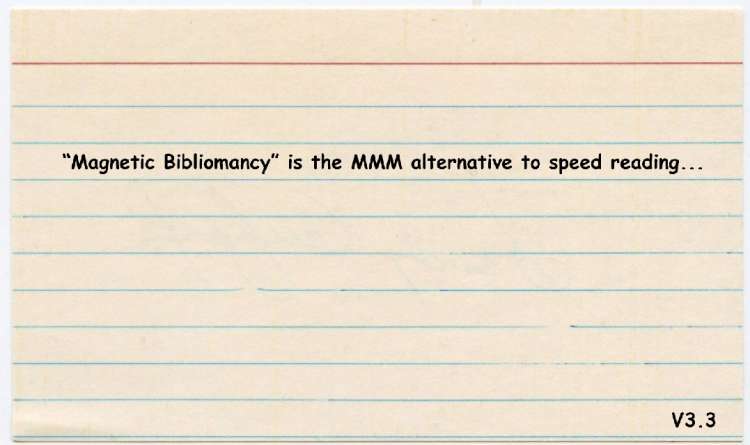
However! When we're talking about how to memorize a textbook, we do have a certain mania for index cards. In fact, it's part of what I call "Magnetic Bibliomancy."
To join in the fun, grab an index card and let'southward get started.
First, write downwards the name of the writer, the title of the book, and the bibliographic information.
Delight note: at that place is certain bibliographical (or paratextual) information that doesn't demand to take up space in your Retentiveness Palace. And if you regularly use memory techniques, yous'll find yourself arresting that information anyway. But I don't tend to offering Memory Palace space to it, since alphabetize cards are something you can hold onto.
At present y'all'll have i index menu that has all the bibliographic information of the volume. Number this card in the superlative left corner — number 1. (I always characterization my alphabetize cards in the top left corner.)
Next, yous'll brainstorm to make full out your other index cards.
>>> Yours Free: A Individual Class With Cheat Sheets For Condign A Retentivity Master, Starting From Scratch.
4. Find the large points and jot them down
Now that you're all organized and have your program, information technology'south time to become down to business organization.

Considering you read the introduction, paratextual materials, and the conclusion, you should already take an idea which chapters y'all want to read first. You don't have to start with the first affiliate! At that place'southward a loftier likelihood that your heed already decided how to prioritize your reading efforts.
Remember, for the purposes of this web log mail service, we're looking for three primary pieces of information out of each chapter. So, there are 3 pieces of information you're going to walk away with from whichever chapter you read first.
Yous have your index cards set to go, and you're ready to offset writing downwardly the key pieces of data on each card, numbering them the same style (in the summit left corner).
You will want to have some sort of indication on each carte du jour nearly where you are in the book. This has to do with what I call the "buying mindset" for textbook memorization. You lot've already adopted the mental attitude that you're going to succeed. You literally want to feel like you ain the fundamental information in your textbook.
Ane way you can have on this mindset is to pretend you're a talk show host on a pop evidence or podcast, and later this evening you get to interview the author of the textbook. Millions of people will exist watching or listening, so you actually need to know your stuff. And yous need to be able to read the book fast.
When you employ this mindset, it allows y'all to ask questions while you're reading. You lot get really curious about the topic, and instead of passively reading you finish upward engaging with the text. There'southward pressure: time pressure, the fact that you lot're going to interview the author. You lot could even imagine that the author is sitting in that location with you equally you read, and pretend like you lot can read their mind about the answers to your questions.
Studying is a numbers game. I've touched on this, but I want you to categorize everything using a kind of numbers game. And so when you come across a gem of a particular, write it down on your alphabetize card forth with the page number where you found the data, and sometimes the affiliate name or number.
This kind of data always goes in the lesser right corner. And if you lot take secondary ideas, y'all can use the back of the index bill of fare to jot them down. I always do this regardless of whether I've copied down a quote from a volume or merely a annotation or observation.
Here's why I diligently complete this step: if I e'er need the data again, I'll know where to find it.
At this signal, you're not doing whatever kind of memorizing whatsoever. Instead, you're:
- Familiarizing yourself with the material,
- Connecting details with already-known data,
- Learning new information, and
- Gathering new facts and details.
That's it — but memorization is not set withal. You lot aren't memorizing the book equally yous get along, only rather focusing on the book and marinating yourself in information technology.
Adjacent, you lot'll take the information from your index cards and transfer information technology into your Memory Palace.
5. Make use of your Memory Palace
Once you've finished reading the volume and filling out your index cards, it's fourth dimension to place the information into the correct spot in your Retention Palace.
Let's pretend for a moment that our instance textbook had ten chapters. Since we wrote downwardly 3 pieces of information per chapter, we now take 30 index cards. And because nosotros prepared our Retention Palace ahead of time, we have thirty stations prepare to go.
Now information technology's fourth dimension to memorize, magnetically .
In the next step, y'all'll brand your information visually highly-seasoned.
vi. Create crazy imagery to help you recall the info
Take each index menu and call back of an image that relates to the information on your card. Brand the images bright, zany, and exploding with action.

I'll walk you through a few examples so you can meet this step in activeness.
Instance 1: Imagery based on the author's appearance
Let'south take Gerard Genette, the author of Paratext , as an example. If I wanted to memorize cloth from the book Paratext , I would use Gerard as a lexical bridge or Magnetic Bridging Figure, helping me movement from station to station.
Genette reminds me of Gillette razor blades. Not exactly a one-to-one correlation, but I can nonetheless see him shaving in that commencement room, if I needed to memorize that he was the author of Paratext . He would be shaving abroad a bristles with wild ends growing out of his face. For the context of "Paratext" I could pic a pear bouncing up and downward on a textbook, or a can or Para Paint splashing over a book.
Case 2: Imagery based on concepts from the index card
In this case, index carte du jour two says, "A text does not exist outside of the text itself."
It may audio pretty obvious, but we don't often think near the fact that until someone comes along and reads the volume, it essentially doesn't do annihilation. At that place are millions of books standing unread on bookshelves around the world that but exist when someone is reading them or talking most them.
So our minds are kind of texts, and when nosotros read, the 2 texts intermingle. The 2nd station volition feature the book Paratext itself, and words are trying to escape from the pages. And poor Genette is standing there, trying to beat the words back in — because according to him there is no text outside the text itself.
Example 3: Imagery of the author throughout the Memory Palace
To get some of the other concepts in Genette's thinking, I might run across him giving up the boxing and then opening up a chapeau in his head, which is likewise filled with words. I could use Genette for each and every station, doing something related to the primal phrase on the alphabetize card.
I've done this with Aristotle's Nichomachean Ethics . I've washed information technology with Plato's The Republic . I've done it with novels. Done information technology with all kinds of things. Once you get used to it, it's very like shooting fish in a barrel.
And when using this arroyo for Ulysses past James Joyce it'south very like shooting fish in a barrel to see Joyce moving through my Retention Palace, not through Dublin, as he does in the novel.
If I knew Dublin, then I might be able to use Dublin, just I don't. And then I was able to employ a Retentiveness Palace based on a familiar location and I see Joyce going from identify to place then I tin can retrieve the unlike things that are happening in the plot in order to recall them later.
Now yous've seen three different examples of how you might use wildly exaggerated information to help you populate your Memory Palace stations. Remember, these images should e'er be big, bright, colorful, and filled with lots of activeness.
Next, you'll assign each crazy image to its ain station.
7. Stick each crazy image onto a Retention Palace station for recollect
This step is the most straightforward of the x.
Yous will brainstorm with carte du jour number 1, and memorize the biographical data at station number one in the Memory Palace. Then continue on with index card two and station 2, index menu iii and station three… you become the thought.
If you lot already know the writer and title by eye, yous might not need to utilize that kickoff station for biographical information. Use your judgment, so you don't waste valuable retention existent estate.
Since it only takes a second or two to create a actually action-packed epitome for each station, be sure to take the fourth dimension to actually see them in your mind's heart.
Next, you lot'll test your call up.
8. Test yourself before the teacher does
This is the step many people won't have: practice recalling the info past going from station to station.

After you've gone through and used your Retentiveness Palace to put as of information on those thirty cards into the proper station, you lot can make sure the information sticks. Pretend like y'all're testing yourself in a existent exam situation.
Take the details, facts, concepts, and plot points that you lot memorized, and write a summary from retentivity. Your alphabetize cards should exist somewhere else during this exercise — in a box, on a shelf, or somewhere else you can't cheat. And yous tin't look back and along the whole time to brand certain you get things right as you go along.
So, check your summary confronting the index cards. Did yous remember all the points from your cards? Did y'all remember things in the correct lodge?
Finally, it's fourth dimension to allow the data grow into something bigger.
9. Let the info grow into knowledge
I of the almost important stages of this procedure is to turn the data yous memorized into cognition that you can use over and over — not just for this unmarried test or test.
This is one place where the related information that wasn't on your index cards will come up out to shine, as well. You get to see which pieces of data are "magnetic" and stick to your brain. And you lot can start to apply the things y'all learned in other situations, perhaps even bringing some of the information into everyday conversations.
Plus, once you brand the switch from information and data points into knowledge, you lot're much more likely to pass every exam with flight colors!
And speaking of transforming information into noesis, yous can also pull that cognition out of your brain banks down the line. Let's take a look at the 10th and terminal (bonus) step in your memorization process.
10. Bonus! Save your knowledge for later
When you lot're done with your alphabetize cards, don't throw them away!
Once y'all don't need the information for your test anymore, you also don't need to concur the information in your Retentivity Palace. You tin can empty out and reuse your Retention Palace for something else, and let the index cards concur the information for a rainy day.
For example, let's say you memorized the James Joyce novel Ulysses for a literature course. Once you took your exam, you didn't need the information rattling around in your brain, and so yous put the index cards in a box and shelved them away for later.
V years later on, you're asked to give a talk about the novel. You tin simply detect the box with your index cards, reconstruct your Memory Palace, and salve fourth dimension in putting together and memorizing your talk.
There's a high likelihood some of the information volition however be in your encephalon, tucked away in a corner somewhere. And maybe it's there in the course of paleness, or there are some ghosts or fossils of other information y'all've stored in the Memory Palace since then. Simply anything that's still in your retention volition go doubly magnetic afterwards working with information technology again.
One of my university supervisors required me to submit summaries to prove I was reading the books on my reading listing. This is what got me into the addiction of writing out summaries, and I learned very chop-chop that writing summaries out of Retentiveness Palaces was just aureate. This is cloth that – if yous apply it – will alter your power to written report and your agreement of how to have notes from a textbook .
You tin also use your summaries again later. Save them, and you might discover a way to use them for essays, pieces of a publication, or even a Ph.D. dissertation. By using your recollect abilities, you're condign an good on your subject matter.
You lot put stuff in your mind, filter it, and so reproduce it — all without the benefit of looking dorsum and forth at your textbooks or index cards. And through the process, you become a master of data .
At present, I know I said you may not need to memorize your textbooks verbatim, merely what most the situations where you lot do really need to recall things word-for-word? Before we wrap up, let's take a look at a couple of examples of how to practise just that.
Instance: How to Memorize Verbatim
Nosotros'll use the first line of Homer's epic poem The Iliad for this example.
At present imagine this — I used to work (more like play) at Hadey Windey'south school in Burnaby, Vancouver. It was called ELIT or English Language Intensive Training.
She'south got a vibrant, vivid prepare of students who come up to this after-school program for extra training so they can be superstar students, and I was able to develop a lot of teaching effectually memory skills for them. I likewise taught the students other things similar interpretative abilities and essay writing skills, all of which are continued to memory.
And I as well was able to build, from this place, an amazing Memory Palace. I never really thought of using it as a Memory Palace until I was training Hadey in using mnemonic techniques and Memory Palaces, and she really didn't believe it was possible.
I simply happened to have an old translation of The Iliad in my iPhone as we were sitting in a park. And I was explaining Memory Palaces to her, and drawing a map of ELIT, showing her how she could employ a Memory Palace based on the school.
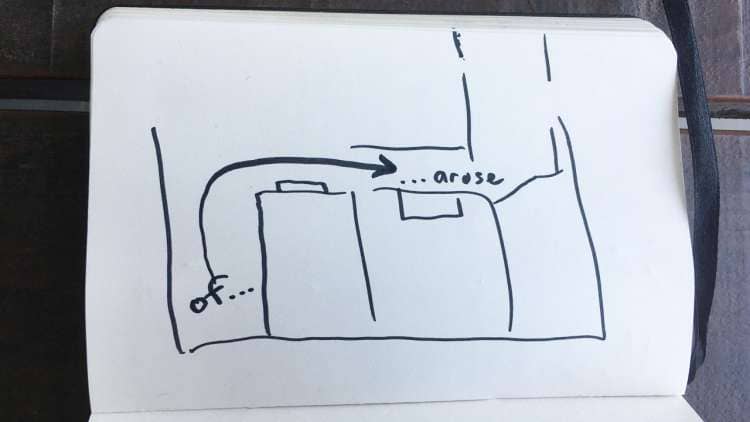
I said, "Here's the kitchen, and the part that I have, and here is classroom number 3, and the computer room," and other things, and I showed how you could make a linear mental journey through this area. Starting in the kitchen, I said, "Imagine I'g limping, and I kick a pail from the kitchen to the door where the Statue of Liberty is continuing. In response, she digs with her shovel into the basis and throws the dirt at my office door where I'thousand standing, writing numbers, and so rubbing the numbers abroad while I'm coughing."
Well, the kickoff thing I want to point out is that all of these images are laid out along a journey. It starts in the kitchen so goes to the door of the kitchen. Then an activeness goes through the hallway to the door of my office. And other parts comport on through classroom number iii and the estimator lab and so forth. But I'g limping, which reminds me of Achilles, because of Achilles' heel. I kick a pail. Moving on to the pail, Achilles' father is Peleus. Now, I don't need to have the whole Peleus, only pail is plenty to remind me of Peleus.
So, "Of Peleus' son, Achilles," the pail is now kicked at the Statue of Liberty. "Sing, O Muse." Now that's personal to me. The Statue of Liberty means muse to me. Information technology'southward merely considering it's a woman in a gown, I guess — it works for me.
The hardest thing to teach almost Memory Palaces and associative imagery is that y'all need to use what works for you. Y'all need to draw from your own personal puddle of images based on other things that you know. You're creating associations. And so it might not make sense to y'all, merely, to me, it makes a great deal of sense.
"Of Peleus' son, Achilles, sing, O Muse." Me, limping, kicking a pail at the Statue of Liberty, that brings dorsum "Of Peleus' son, Achilles, sing, O Muse. The vengeance, deep and deadly" which is the next line — so the Statue of Liberty is actually angry about this, only instead of attacking dorsum at me, she digs into the earth with vengeance — "The vengeance, deep and deadly; whence to Greece unnumbered ills arose."
So she's throwing this dirt at my office door, and I didn't really demand to think about the fact that it was taking place in Greece. Any time that you don't demand to memorize something, don't worry well-nigh putting information technology in the verbatim, considering verbatim is a weird thing. Basically, if you don't need it and it comes dorsum naturally, don't create an image for it.
And so, "Whence to Greece unnumbered ills arose," well, what am I doing as this dirt comes at me? I'm writing numbers, then I'one thousand wiping them away. Unnumbered. And I'yard coughing, I'm sick — ills. "Whence to Greece unnumbered ills arose."
That's a very unproblematic example. I created a vignette since it'south not actually a single epitome or a ready of images. And I did this on and on and on for as much of The Iliad every bit I wanted to memorize to create this case for Hadey. And she was blown away.
After that, she came dorsum ii days later and had memorized 100 words of English vocabulary. (English is non her starting time language.) She was really skeptical at first, simply that's how I finally convinced her to give this a endeavor. At present she's office of Toastmasters, and she's giving speeches left, correct, and center, right from her listen, directly from using the Magnetic Memory Method.
Now, it'due south important to remember that this instance was how to memorize a poem verbatim, and you may not need to memorize your entire textbook discussion-for-word.
And in additional practiced news, you can utilise this method for anything you desire to recollect — it doesn't matter whether it's a formula, poetry, a quote, phrase in a foreign linguistic communication, or a textbook.
Memorization is memorization, when yous get right down to it.
The reality is that you can have a spoon or a bucket — the bounding main of data doesn't care. The retentivity techniques and your encephalon care for all information as well. It's only the ego that sees a difference, and lack of preparation with the retentivity tools makes information technology more than hard.
And finally, since our intrepid reader asked specifically nearly how to memorize a formula, I'k adding a bonus case to assist anyone who needs to memorize them.
>>> Yours Gratuitous: A Individual Grade With Crook Sheets For Becoming A Memory Master, Starting From Scratch.
Bonus Example: How to Memorize a Formula
Let'due south besides pause down an example of how verbatim memorization works when you need to remember a formula. We'll employ the example our reader asked well-nigh:
sin(A+B)=AcosB+cos
As always, nosotros want to showtime with a well-formed Memory Palace first.
I think of my friend Shannon because her proper name starts with 'South'. I was just in her apartment once to watch a James Bond moving picture, just that'southward all I need to go a good Retentivity Palace rolling.
Adjacent, I start creating Magnetic Imagery to encode the first function of the formula. Since the devil is the boss of "sin," I put him on Shannon's couch (a micro-station). To memorize the character "(" I make it a bulldozer. It drives over an Apple estimator, which draws upon another technique entirely, called the pegword method .
From this A for Apple calculator, an arm emerges and tosses a crucifix at Batman. Why? Because a crucifix is a good retention tool for remember, and Batman helps me retrieve "b."
At present all I have to do is have Batman heighten his shield — thus closing this function of the formula with the ")" symbol. But this shield is special because it has 2 guns to represent the = sign. And so Al Pacino "accosts" Batman throwing a crucifix at Cookie monster wearing Batman "cosplay."
I know that this procedure might audio similar a lot if you're a beginner, but you'll pick it up quickly. And you should — it's powerful!
So there you have it. Your ten-step cheat sheet for how to memorize a textbook or formula… or whatever other book you want to remember.
How to Study a Textbook for Maximum Retentiveness
Remember that scenario at the get-go of the post? The 1 where exams were on the horizon, and you lot were feeling woefully unprepared?
Now you know how to make up one's mind how much reading you lot actually demand to do, how much memorization is on your plate, and the best mode to memorize your textbooks so you lot retain every bit much information as possible.
Almost importantly, you sympathize that memorizing a textbook isn't equally difficult equally it might seem!
You're on the right rail to ace your exams and create a whole new set of knowledge that you lot can use now and into the future.
And if you lot experience like you could use a piddling bit more than of a memory heave before your exams, bank check out my gratis retentiveness improvement kit.
Supplementary Viewing
Source: https://www.magneticmemorymethod.com/how-to-memorize-a-textbook/
0 Response to "How to Review an Entire Deck on Anki"
Post a Comment