what states were admitted to the union as part of the missouri compromise

23c. The Missouri Compromise
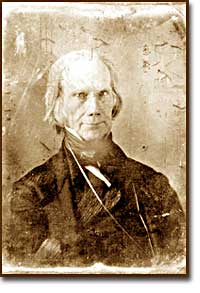
Henry Clay was first elected to the Senate in 1807, earlier his 30th birthday. This was against the rules prepare upward in the Constitution that stipulated xxx as the youngest age for a Senator.
Most white Americans agreed that western expansion was crucial to the wellness of the nation. Merely what should be washed about slavery in the Due west?

The contradictions inherent in the expansion of white male voting rights can as well be seen in problems raised by western migration. The new western states were at the forefront of more inclusive voting rights for white men, but their development simultaneously devastated the rights of Native American communities. Native American rights rarely became a controversial public issue. This was not the case for slavery, even so, every bit northern and southern whites differed sharply virtually its proper role in the west.
The incorporation of new western territories into the United States made slavery an explicit business organization of national politics. Balancing the interests of slave and gratis states had played a office from the very starting time of designing the federal government at the Constitutional Convention in 1787. The crucial compromise there that sacrificed the rights of African Americans in favor of a stronger wedlock amongst the states exploded once more in 1819 when Missouri petitioned to join the U.s.a. as a slave state.
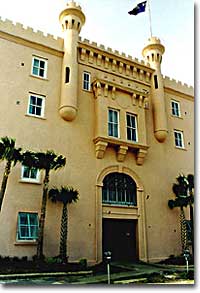
The S Carolina Country Arsenal, nicknamed the "Old Citadel," was constructed subsequently Denmark Vesey'south slave uprising in Charleston, S Carolina.
In 1819, the nation independent eleven free and eleven slave states creating a rest in the U.S. senate. Missouri's entrance threatened to throw this parity in favor of slave interests. The debate in Congress over the admission of Missouri was extraordinarily bitter afterward Congressman James Tallmadge from New York proposed that slavery be prohibited in the new state.
The debate was especially glutinous because defenders of slavery relied on a central principle of fairness. How could the Congress deny a new state the right to make up one's mind for itself whether or not to allow slavery? If Congress controlled the decision, then the new states would take fewer rights than the original ones.
Henry Clay, a leading congressman, played a crucial role in brokering a two-function solution known equally the Missouri Compromise. First, Missouri would be admitted to the union equally a slave state, but would be balanced by the admission of Maine, a free state, that had long wanted to be separated from Massachusetts. 2nd, slavery was to be excluded from all new states in the Louisiana Purchase north of the southern boundary of Missouri. People on both sides of the controversy saw the compromise as deeply flawed. Still, it lasted for over thirty years until the Kansas-Nebraska Human action of 1854 determined that new states north of the purlieus deserved to be able to exercise their sovereignty in favor of slavery if they so choose.
Democracy and self-determination could clearly be mobilized to extend an unjust institution that contradicted a fundamental American commitment to equality. The Missouri crunch probed an enormously problematic area of American politics that would explode in a civil war. Every bit Thomas Jefferson observed about the Missouri crisis, "This momentous question, like a fire-bell in the night, awakened and filled me with terror."
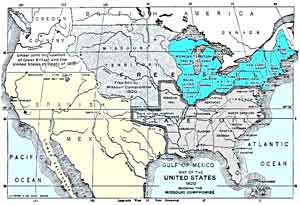
In an try to go along a legislative rest betwixt the pro- and anti- slavery factions, the Missouri Compromise delineated which states would be complimentary and which would not.
African Americans apparently opposed slavery and news of some congressional opposition to its expansion circulated widely within slave communities. Kingdom of denmark Vesey, a free black living in Charleston, Due south Carolina, fabricated the most dramatic utilize of the white disagreement about the future of slavery in the west. Vesey quoted the Bible besides as congressional debates over the Missouri issue to denounce slavery from the pulpit of the African Methodist Episcopal church where he was a lay government minister. Along with a fundamental ally named Gullah Jack, Vesey organized a slave rebellion in 1822 that planned to capture the Charleston arsenal and seize the metropolis long plenty for its black population to escape to the complimentary black republic of Haiti.
The rebellion was betrayed just days earlier its planned starting date and resulted in the execution of thirty-five organizers as well every bit the destruction of the black church building where Vesey preached. Slaveholders were clearly on the defensive with antislavery sentiment building in the north and undeniable opposition among African Americans in the due south. As i white Charlestonian complained, "By the Missouri question, our slaves thought, in that location was a charter of liberties granted them by Congress."
African Americans knew that they could not rely upon whites to end slavery, but they also recognized that the increasing carve up between due north and south and their battle over western expansion could open opportunities for blacks to exploit. The nearly explosive of these futurity black actions would be Nat Turner's Virginia slave defection in 1831.
Source: https://www.ushistory.org/us/23c.asp
0 Response to "what states were admitted to the union as part of the missouri compromise"
Post a Comment